B-HIVE Structure Highlight: Probing R-loops’ role in viral interactions
Introducing R-loops
Throughout the genome, structures called R-loops form when an RNA strand binds to a strand of DNA, leaving the other strand . . . well . . . stranded. These R-loops pose a host of questions about their formation and their interaction with proteins and biological processes. But technological limitations have left much of the mystery of R-loops in the dark.
At Emory University, the lab led by B-HIVE Collaborative Development Program grantee Charles Bou-Nader is working to bring to light the story of R-loops. It’s more than a curious phenomenon of biology. R-loops may be a fundamental part of immunology and virus-host interactions, particularly in retroviruses like HIV-1.
By exposing a strand of DNA, for example, R-loops can facilitate DNA breaks in immunoglobulin genes to produce novel forms of antibodies and increase antibody diversity. But the same DNA exposure can also create harmful mutations. Many unanswered questions about R-loops remain, such as how they form, control gene expression or impact DNA replication and genome integrity. Bou-Nader’s lab is advancing research methods to understand how R-loops contribute to both health and disease.
Advances in imaging and AI
To understand the nuances of R-loops, researchers first need to be able to see them. Thus far, the behavior of R-loops has not been comparable to that of proteins or linear nucleic acids. Artificial intelligence models aren’t helpful in predicting their behavior due to a lack of data. So researchers need new imaging methods to understand the whys and hows of R-loops. Bou-Nader’s lab is developing a method to image R-loops using cryogenic electron microscopy.
Once the lab’s imaging method begins producing detailed data, the next task will be to develop rules and principles for R-loop behavior. These rules will help predict, for example, which R-loops will regulate gene activity and in which way. Such rules will also help guide understanding of how proteins interact with R-loops. Machine learning approaches are helping researchers work with the data that currently exists to predict how proteins bind to R-loops and where R-loops might form on the genome. These models are still being refined, and an increase in data can only improve the accuracy of their outputs.
What this tells us about HIV-1
R-loop research and HIV-1 research overlap in studying the integration of the viral genome into the host genome. R-loops, some researchers hypothesize, may be targets for the intasome, the complex of proteins that initiates and facilitates viral integration. If true, this would add a twist in how HIV-1 hijacks R-loops to integrate in the genome and establish a long-term infection.
R-loop research might show how the intasome recognizes R-loops, Bou-Nader says. His Collaborative Development Program grant, in part, applies his developing R-loop imaging approach to HIV-1 integration. Understanding R-loop-intasome interactions could reveal druggable targets that could interrupt the integration process and prevent the virus from taking hold in hosts’ genomes.
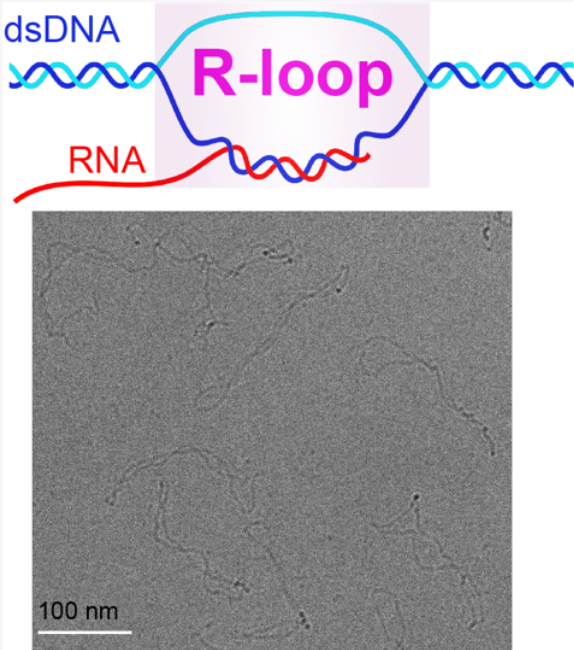
A schematic of an R-loop (top) and a representative micrograph of an R-loop studied by cryo-EM (bottom).
Meet the Researcher
How did you get interested in science?
I was interested in science since I was a kid, really. That was always my passion. When I was very young, probably 5 years old, I was interested in philosophy. I was asking a lot of questions. I learned that there’s all these big thinkers that had also the same questions and have different answers to them. In French, we have a word for that. We call them savants.
I realized that science is what really drives me. I think I was maybe 7 years old, and I said, “Yeah, I want to be a scientist.” I didn’t know what that meant. I didn’t know what I need to do to do that, because no one in my family is a scientist. But I just knew that I wanted to be able to focus my energy thinking about complicated questions and trying to answer them.
I was born in France. My hometown is where Louis Pasteur was born, so I would hear about him, his accomplishments, pasteurization, vaccines, and all these things. So I said, “Wow, this single human being, by being curious and intellectual, has made such a huge impact on humanity.” And so that sealed the deal for me. When I was young, I saw scientists as superhumans that changed the direction of humanity. I thought that was so noble.
Now, of course, it’s very different. Once you end up being a scientist, you realize that those are very unique trajectories. But that was my initial motivation—seeing the impact of those big thinkers on our society and hoping to contribute in whatever way I can.
Tell us about the lab where you did this work.
Our lab is at Emory University. There’s a big nucleic acid community here, so there’s a lot of colleagues one can interact with. There’s also a huge immunology community at Emory, and since my postdoc era I’ve always been interested in the virus/host interface. There’s also a lot of people that work on HIV at Emory. In my current lab, we have some targets linked to HIV. So, for me, it was a natural fit.
From a technological perspective, Emory has a lot of fantastic cores that really support our work. For instance, we have the Cryo-EM core that’s really important for us to do our imaging and optimize our conditions. The core has all the required instrumentation and wonderful staffs that support the research labs.
Atlanta is nice, of course. It’s a big city—that’s also important, at least from a personal perspective. But everything that we needed in terms of technology, talents, colleagues, potential collaborators, environment, was at Emory.
I’m in the School of Medicine, and that to me was important because my passion is research. It’s really research that gets me up in the morning. Being in the School of Medicine, my time is much more dedicated to research than other obligations that might take away from that.
What are the biggest challenges you’re facing?
Our dream is: Can we see R-loops at high resolution, and can that help us explain how they work in biology? So that’s really a big, big objective, and part of that is this new technology that we’re developing to image them by Cryo-EM. And already our preliminary data is showing that the structures they form are completely unexpected. There’s new folds and new ways that nucleic acids can form that we did not know about, because no one has seen or studied these structures at this scale.
We want to build an atlas of different types of R-loops. Can we maybe classify them based on their structures? Is there a fundamental rule behind what makes an R-loop? What makes an R-loop maybe harmful? Is there a fundamental rule, motif, signature, etc. that can help us predict what an R-loop might be doing? So when labs map by sequencing thousands of R-loops, for most of them, we have no clue what they do. It’s a very fundamental, challenging objective, but this is really what excites our team every day. Can we figure out some of those rules to understand R-loop biology? We also hope that this type of work we’re doing might be used to train AI and machine learning approaches to help predict whether a protein can interact with an R-loop, and how it would do it. Long-term we hope this work will uncover new paradigms of gene regulation and chart how R-loops contribute to different biological pathways in human health.
What are you working on now?
I was trained as a hardcore structural biochemist and so this is really my core expertise. But I think a good scientist needs to be very flexible and learn new techniques, because the methodology should not be the limiting step. We should be focused on the questions that we ask and their impact. The questions will drive the technology and push us to expand our technical skillset and toolkit. This is why we’re developing new techniques to study R-loops.
We have a couple of studies coming together where we are solving structures of proteins that interact with R-loops. And those structures are really surprising, because those interactions are completely different from what one would expect. But more importantly, they reveal that there’s new ways that proteins can track nucleic acids that’s completely different from what the field already knows in terms of classical DNA or RNA interactions. So that, to me, is very exciting, because there’s this whole set of interactions that we didn’t know about, and of course AI doesn’t know about, because they haven’t been seen before, so you can’t even train AI to guess them or predict them. It’s been very exciting.