
B-HIVE Laboratory Highlight: A correlative light and cryo-electron microscopy (CLEM)platform to identify HIV-1 capsid structures
Visualization of HIV-1 core components and infection dynamics
To those studying the story of HIV-1, so many questions about the capsid and its progression through nuclear pores are made significantly easier to answer if they can just see it. An ability to image the capsid, only around 100 nanometers long, can provide the detail about the infection process to help disrupt it.
At Florida State University, B-HIVE Collaborative Development Program grantee Ashwanth C. Francis and his colleagues are using labeling approaches and efficient biochemical methods to clarify parts of the capsid’s journey. These methods can reshape what we know about how HIV-1’s core is disassembled for integration of the viral DNA into host genomes.
The lab uses two non-invasive labeling techniques that Francis pioneered during his PhD and postdoctoral studies. The first one uses a Vpr-integrase-superfolder GFP to fluorescently mark the integrase protein that mediates integration of viral genetic material into host genomes. This marker can also be modified to contain different fluorophores, based on context, to enable visualization of the HIV-1 core replication complex residing inside of the capsid.
The second one was in the development of the CypA-DsRed, a fluorescent marker that attaches to the capsid via the engineered host protein cyclophilin-A. This marker binds tightly to the outer surface of the capsid, and its loss reports capsid disassembly during the uncoating process.
These two fluorescent markers enable simplified and highly efficient labeling tools to visualize HIV-1 capsid biology in vitro and describing the infection process in real-time inside cells.
Imaging tools accelerate HIV-1 structural studies
Sample purification in traditional capsid studies involves purifying hundreds of milliliters of viral sample into a few microliters of capsid sample, which is then used to study the properties of the capsid and how it responds to small-molecules and antiviral compounds. This process of capsid purification can take more than a week. While the conical shape of the capsid is well defined, the way the structure changes during disassembly—a process referred to as uncoating—remains unclear.
Francis’ fluorescently labeled viruses, display distinct red and green markers and can be monitored by a confocal microscope. They report on the condition of the capsid uncoating along with the state of the viral genetic material. This approach, which requires only 50 microliters of viral supernatant is able to reveal the dynamic process of capsid disassembly with results returned in about 30 minutes. This simplifies capsid-related studies and enables rapid sample preparation procedures to accelerate HIV-1 structural research.
Using this approach, Francis’ team evaluated the effects of several small molecule compounds on the capsid’s biophysical properties. While fluorescence confocal microscopy can reveal how the capsid disassembles in real-time, it lacks the resolution to describe the structural states of these uncoating capsids. However, locating HIV-1 capsids in cryo-electron microscopy, which can provide atomistic understanding of its structure, is highly challenging.
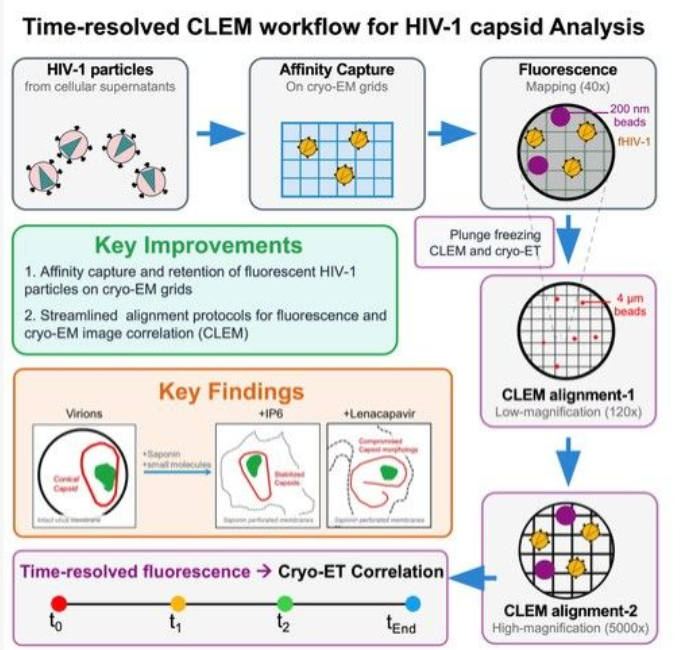
To address this limitation, Francis’ recent collaborations with B-HIVE member Gregory Melikian have developed an elegant method to capture virions on the electron microscopy grids. The method targets the virus envelope, outside the virus membrane, using antibodies. This improvement allowed them to image the location of the individual virus particles on the grid, including their uncoating profiles, which are determined by time-resolved fluorescence studies. Then they iteratively developed distinct markers to align the fluorescence image maps obtained from the cryo-EM. Using this overlaid map, they identified the location of virus particles and of capsids for high-resolution structural imaging of the HIV-1 core. This technique requires only 5 microliters of viral supernatant and is reproducible, reaching around 80 to 90% efficiency in structure determination.
What this tells us about HIV-1
Efficient sample preparation enables increased-throughput in HIV-1 capsid related studies. The approach was further validated by B-HIVE collaborators in Dmitry Lyumkis’ group. They identified different states of capsid stabilization. Lyumkis’ group found that the capsid assembly co-factor IP6 leads to stabilization of conical capsid shells, while the clinical inhibitor Lenacapavir which binds at a different site on capsid leads to its hyper-stabilization resulting in its breakage, thus disrupting capsid functions in side cells.
Meet the Researcher
How did you get interested in science?
I remember an early (and unsuccessful) experiment from when I was about 10 or 11 years old—pouring red, black, and blue ink into plant pots to see if I could change the color of the leaves. Unsurprisingly, the plants did not survive, but that curiosity—to test ideas, even imperfectly—left a lasting impression. A few years later, as part of the Indian Scouts movement in the 1990s, I participated in HIV/AIDS awareness marches. Those experiences made me acutely aware that stigma is one of the most damaging aspects of the disease, often forcing people into silence while they struggle with a devastating infection.
When I finished high school, I had to choose between medicine, engineering, and science. Given financial constraints, I chose to pursue science—a decision my mother fully supported, even as she was prepared to take on loans for my education. I completed my undergraduate degree in microbiology, where I was eventually introduced to virology. Viruses quickly became my primary focus: their small genomes and remarkable ability to hijack host systems fascinated me. I went on to pursue a master’s degree in biotechnology at Loyola College in Chennai, a great place to study. I was inspired by molecular biology: cutting DNA pieces, manipulating them, making chimeras, and studying how proteins work, was fascinating to me. For my thesis, I worked with Soumya Swaminathan on tuberculosis in pediatric HIV/AIDS patients. Under her mentorship, I studied cross-reactive antibody responses between tuberculosis and HIV antigens, work that ultimately led to a publication and gave me my first experience of scientific discovery.
My research journey led me to Italy where I received a full scholarship to pursue PhD studies at the Scuola Normale Superiore in Pisa, under the mentorship of Anna Cereseto. Working with her was an experience that fundamentally shaped my career. Back then she was developing integrase-based fluorescent labeling tools to visualizeHIV-1in cells. My first question was: “You can see these particles? You can see these viruses inside cells?!”, and then there were all these colors associated with fluorescence microscopy, each one giving new information. I was immediately captivated by the approach and the ability to see dynamic processes in real time.
At that time, I thought “Oh, I’m going to knock this out.” However, working with integrase proved technically challenging, and progress was slow. Over time, I modified integrase extensively to improve infectivity while preserving its utility as an imaging tool. This work culminated in a 2014 publication demonstrating how viral labeling impacts infectivity and how these limitations can be mitigated. After completing my PhD, I moved to the United States for postdoctoral training with Gregory Melikian, whose seminar I had only seen online. During my interview, I proposed using cyclophilin A as a capsid marker to visualize HIV-1 in cells, a project I later pursued in his lab. His mentorship was transformative, and together we worked closely to develop approaches that enabled visualization of key steps in the viral life cycle. One of my long-standing goals, even during my PhD, was to capture the full 24-hour life cycle of HIV-1 infection, from cellular entry through integration,t hat takes place inside the nucleus. During my postdoctoral training, that vision began to take shape through the development of live-cell imaging approaches. Every new thing we learned led to more and more questions.
Driven by these advances, I established my independent lab to focus on nuclear entry, integration targeting, and the structural underpinnings of these processes. Our work now aims to bridge fluorescence imaging with structural biology, while maintaining a strong emphasis on rigorous training and mentorship—principles I carry forward from my own mentors.
Tell us about the lab where you did this work.
Our lab is based at Florida State University in Tallahassee, Florida. I hold a faculty position in the Department of Biological Sciences with a joint appointment in the Institute of Molecular Biophysics. The campus provides an excellent research environment, with a warm climate and a vibrant, green setting.
We are equipped with advanced imaging platforms, including a live-cell confocal microscope and a confocal.nl re-scan point scanning system capable of multiplexed imaging across more than five channels. We also have access to high-end structural biology infrastructure, including a Titan Krios 300 kV cryo-electron microscope and a recently acquired cryo-FIB-SEM, enabling visualization of HIV-associated structures in situ within cells. Our laboratory operates fully functional biosafety level (BSL)-1 and BSL-2 facilities to support virological work.
Our lab currently includes approximately 13 members, including three postdoctoral fellows, five core graduate students, and two co-mentored graduate students specializing in machine learning and nucleic acid structure. We also benefit from the support of three technicians. In addition, we provide research training opportunities to 30–50 undergraduate students, many of whom participate in journal clubs and undertake independent or collaborative projects alongside graduate students and postdocs.
While administrative responsibilities occupy a significant portion of my time, I remain actively engaged in the lab, working directly side-by-side with trainees and contributing to experimental work and mentorship.
What were the biggest challenges with this study?
We aim to understand how the HIV-1 capsid dynamically remodels its structure to coordinate multiple stages of infection. This presents a fundamental paradox: the capsid must undergo partial disassembly to progress through infection yet retain sufficient structural integrity to preserve function. Live-cell imaging approaches have provided important insights into capsid behavior during infection, but they lack the resolution required to fully define the structural extent of capsid remodeling in cells. These studies have revealed that only a small fraction (~2%) of incoming capsids successfully enter the nucleus, and an even smaller subset proceeds to productive integration into the host genome. This raises the question: how does a capsid that must destabilize regain or maintain a functional architecture?
A major challenge however is the timescale of these processes, which occurs over the course of several hours. Additionally, identifying capsids within the crowded cellular environment by electron microscopy further complicates these efforts, particularly when attempting to capture transient intermediates of capsid remodeling. While a few papers are out there showing capsid structures inside cells, identifying those few capsids that actually establish infection is another major challenge to the field.
What are you working on now?
The obvious future direction of the current work is to develop comparable CLEM approaches to visualize capsid structures inside cells, in their native environment while they coordinate HIV-1nuclearentry and position the virus at integration sites. We are developing correlative imaging approaches that link fluorescence dynamics which can identify distinct capsids with functional outcomes with their corresponding ultrastructural information inside cells.
We are continuously developing innovative labeling strategies including newer non-invasive capsid labeling and viral DNA labelling to track of structural changes at high spatial and temporal resolution. In particular, we aim to develop approaches capable of reporting on conformational changes at the level of individual capsid hexamers or even monomers, thereby providing a more precise understanding of capsid dynamics during infection.